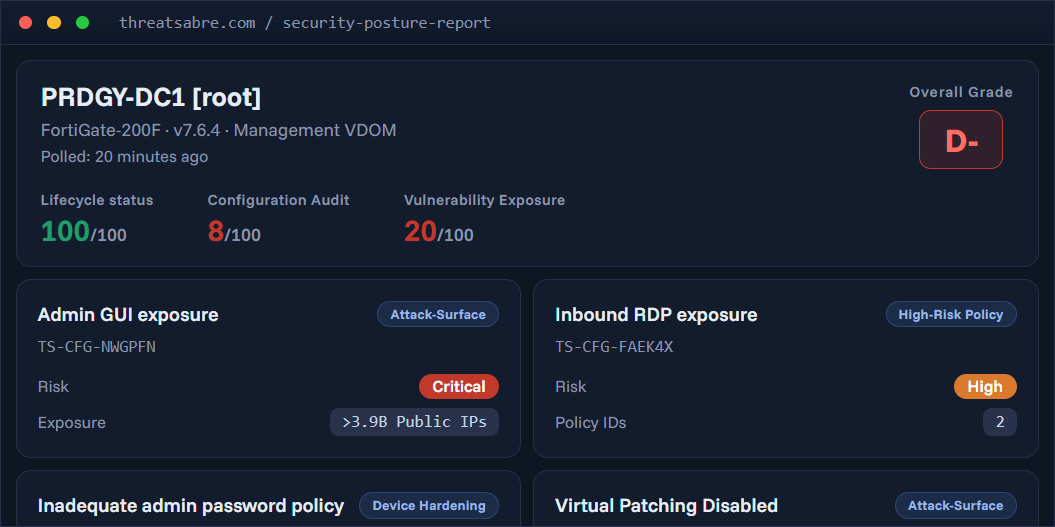
Configuration risk
Catch high-risk configurations and policy weaknesses as they appear, measured against a consistent baseline.
Network Security Posture Management
Automatically scores new advisories against your real configuration to expose true risk.
Technology Alliances
 Click here for solution brief
 The problem
Firewall and SD-WAN appliances sit on the perimeter, between the internet and your private networks, controlling how traffic flows and who reaches your most sensitive systems. That makes them one of the most actively targeted assets you operate. The Five Eyes cyber security agencies have warned that AI is “shrinking the window between vulnerability discovery and exploitation ever more quickly”. AI-automated attacks against firewall appliances have already been observed in the wild. Any exposed flaw is highly likely to be exploited.
Why ThreatSabre
A strong posture depends on sound configuration, contextual vulnerability risk, and active lifecycle management working together. Each adjacent class of tool only covers a slice, and none was built for these devices.
Combine vulnerability assessment and external attack surface management. They match firmware to known CVEs, or scan from the outside, but can't see a device's real configuration, enabled features, or reachable attack surface.
Strong on multi-vendor rule hygiene, change management, and policy optimisation, but operationally heavy to run, and blind to vulnerability risk and device lifecycle.
ThreatSabre integrates at an API level and applies a deep understanding of how these devices operate, the common configuration mistakes that lead to high-risk exposure, and how each vulnerability impacts individual devices based on their specific configuration. It rolls this up into the ThreatSabre Security Benchmark, a holistic measure of each device's risk that prioritises the issues with the highest impact and the clearest path to resolution.
How it works
Continuously map exposure across every device, weigh each vulnerability against its real config, and respond to what actually matters.
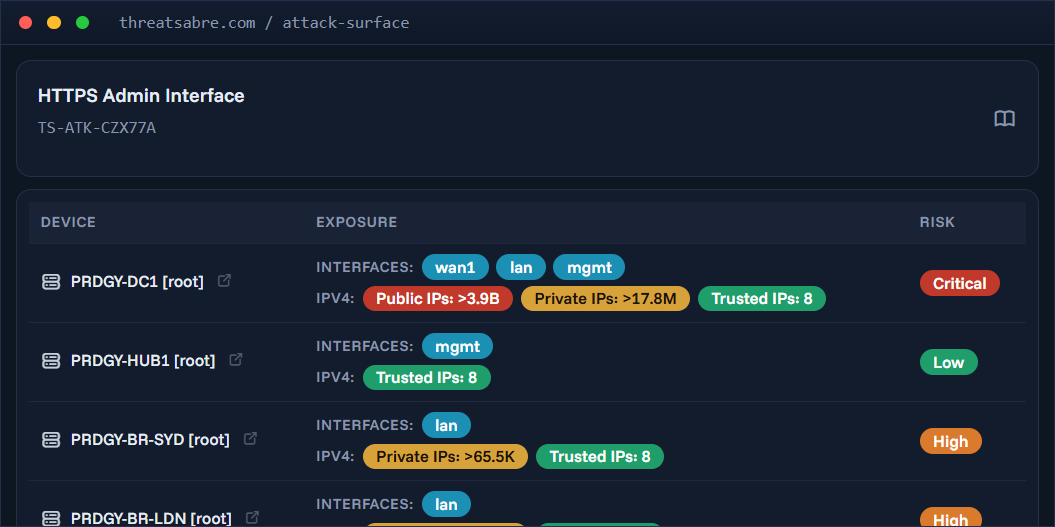
Build a complete picture of every device's exposure across interfaces, services, VIPs, trusted hosts, and local-in and firewall policies. That picture powers your posture rules and vulnerability assessments to surface true, contextual risk.
Continuously measure every device against the ThreatSabre Security Benchmark, a holistic view of risk that weighs attack surface, high-risk firewall policies, device hardening, exposed vulnerabilities, lifecycle and more. The benchmark is tuned to what genuinely impacts security and operations.
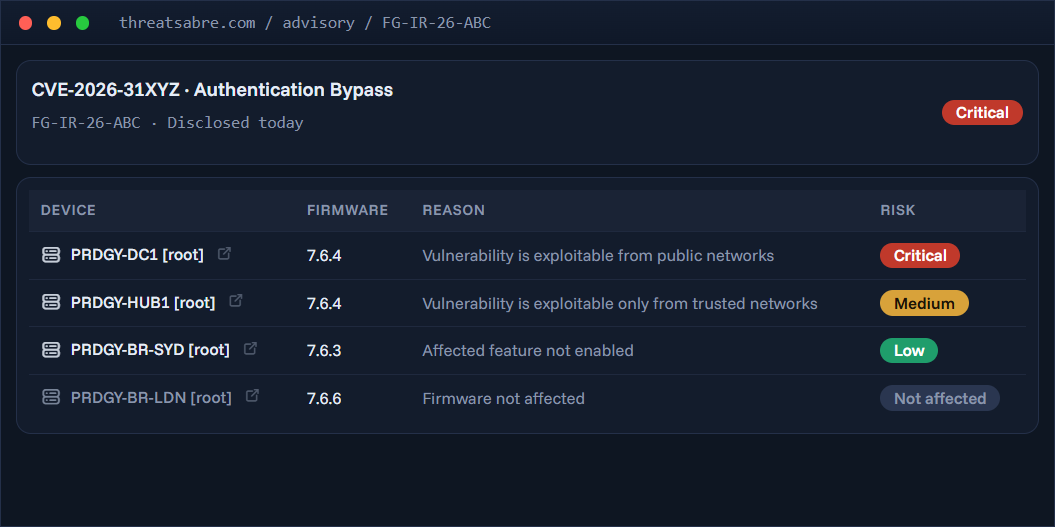
As each new vulnerability is disclosed, ThreatSabre rates its real risk to every device: is the affected feature configured, how is it exposed, and could it actually be exploited? Teams act immediately on what's genuinely critical and keep pace with a relentless stream of disclosures.
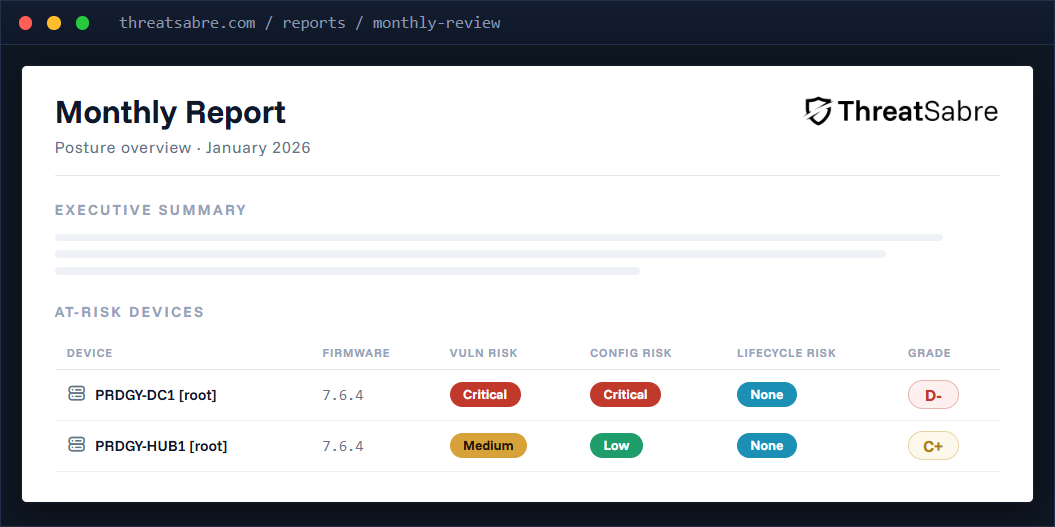
Get the critical data out of the platform and in front of stakeholders, from an MSP's monthly customer report to a CISO briefing on the latest vulnerability impact. Alerts complement the reporting, notifying your team the moment something important changes, such as a high-risk configuration or a newly disclosed vulnerability affecting your devices.
Contextual risk rating
Security teams can't action every advisory at once. ThreatSabre scores each new advisory against every device's real configuration, so your team acts immediately on what's genuinely exposed and can confidently deprioritise what isn't, with the evidence to show stakeholders. Less noise, more time for the work that matters.
Same advisory · prioritised by per-device impact. Illustrative example.
Complete coverage
ThreatSabre rolls configuration, vulnerability and lifecycle risk into one benchmark.
Catch high-risk configurations and policy weaknesses as they appear, measured against a consistent baseline.
Every advisory scored against the actual configuration of each device, not a generic CVSS number.
Firmware and hardware lifecycle, support and licensing, surfaced before an end-of-support date becomes a problem.
Solutions
Offer managed firewall services backed by ThreatSabre. Differentiate your service with a credible posture and vulnerability story that wins and retains customers, and prioritise across every tenant during global events.
Complete visibility and risk-based prioritisation across your whole fleet, with continuous compliance, lifecycle management and independent assurance.
FAQ
ThreatSabre currently supports Fortinet FortiGate next-generation firewalls, including FortiGate Rugged and FortiWiFi models. Devices can be connected directly or through FortiManager and FortiManager Cloud, and support for additional platforms is on the way.
Through a lightweight, standalone Linux agent installed with a simple script. It runs almost anywhere Linux does, from cloud platforms like AWS, Azure and GCP down to a Raspberry Pi. The agent connects read-only and needs only outbound HTTPS access to our platform and to the devices it polls. It can be locked down tightly and supports full SSL inspection.
Onboarding is straightforward and typically takes as little as 10 minutes.
Book a personalised demo and see how ThreatSabre improves your security posture.